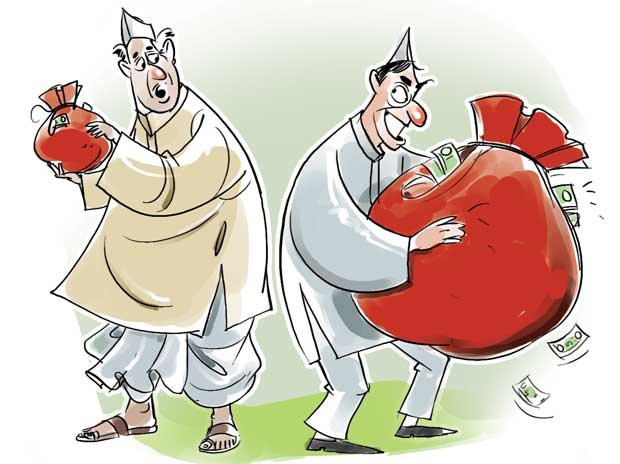
There is a silent, unacknowledged tragedy unfolding every single day in the world’s largest democracy. It is not an overnight catastrophe, nor is it a sudden natural disaster that captures the world’s attention. Instead, it is a slow, agonizing, and deliberate bleeding of the nation’s wealth. Every time an alarm clock rings in a middle-class Indian household, a citizen wakes up, prepares for work, and steps out into the chaos of the city. They toil for eight, ten, or twelve hours a day, sacrificing their youth, their peace of mind, and their family time to earn a livelihood. Before the money even reaches their bank account, the government takes its cut in the form of direct taxes. And when that citizen steps out to buy a packet of biscuits, pay for a child’s school fee, or fill a liter of petrol, the government takes another massive bite in the form of indirect taxes. We are a nation that is taxed relentlessly, yet we live in conditions that often resemble the poorest nations on earth.
Where does this hard-earned, blood-soaked money go? It vanishes into the dark, bottomless pit of a system designed not to serve the public, but to exploit them. The public taxpayer money, which should be the sacred fuel for national development, is being wasted with a level of brazen arrogance that borders on the criminal. Let us dissect, piece by piece, the grand illusion of the Indian democratic machinery and expose exactly how the public’s hard-earned money is being squandered by those who were elected to protect it.
1. The Lost Infrastructure: A Legacy of Dust and Collapsing Concrete
It is widely believed that the Indian education system, while perhaps not the absolute best in the world in its entirety, is capable of producing world-class minds. Our premier institutes churn out engineers, architects, and planners who go on to build marvels across the globe. The common, logical perception is that if these brilliant engineers were hired by the government to construct our national roads, bridges, and public infrastructure, they could easily build structures that stand tall and strong for a hundred years.
But look at the reality that surrounds us. The situation on the ground is the exact opposite of this optimistic perception. Our highly publicized, multi-crore infrastructure projects—bridges, overpasses, expressways, and dams—routinely collapse, sometimes within mere months or even days after their grand inauguration.
Is this the fault of our education system? Absolutely not. The fault lies entirely in the unholy, deeply corrupt trinity that forms the backbone of any public construction work in India: the greedy contractor, the compromised government servant (the engineer who verifies and certifies the substandard materials), and the political master who oversees the loot. When you observe the recent, tragic trend of newly inaugurated bridges collapsing like a pack of cards, a terrifying reality emerges: no one is ever held responsible. The responsibility for these massive, life-threatening failures is passed around like a hot potato.
For the politicians, the infrastructure project is nothing more than a photo opportunity. Once they cut the ribbon, pose for the cameras, and plaster their faces on the front pages of national newspapers, their job is done. For them, governance is simply an exercise in photoshop and event management. Once the inauguration is over, the bridge and its functionality can go to hell for all they care. The political math is simple: “I got the votes by announcing the project, and I got my corrupt share of the funds during the construction. Whatever happens to the taxpayers’ money afterward is not my problem.”
Nobody at the top cares about this lost infrastructure. A road is built, it washes away in the first monsoon rain, it is rebuilt, it washes away again. A bridge is constructed, it collapses, a committee is formed to investigate, the file gathers dust, and another budget is allocated to rebuild it. This vicious cycle continues forever. Taxpayers’ money is being wasted like spilled water on barren ground. How incredibly hard the common people work to earn this money is a thought that never crosses the mind of any politician or government servant. If the system had even a fraction of a spine, it would hand down the highest, most severe punishments to those who certify collapsing bridges. But our people are sleeping. We are happy to remain ignorant, quietly watching as our hard work is eaten away by corrupt termites.
2. Targeted Welfare Schemes: Emotion, Patriotism, and the Fooling of the Masses
Since the day we achieved independence, a certain class of political leaders realized a dark truth: the people of India can be easily swayed, manipulated, and ruled using the exact same psychological tactics employed by the British. However, instead of using overt force, today’s politicians have devised sophisticated methods to rule Indians by hijacking their minds, their emotions, and their patriotism. They have replaced development-based governance with emotion-based ruling.
Whenever the government fails on economic parameters, whenever inflation rises or unemployment breaks records, our politicians immediately put forward the shield of patriotism. They evoke the image of India as our sacred motherland. They tell the poor, struggling citizen: “Do this for your motherland, give your life for the motherland, sacrifice your comforts for the motherland.” The hypocrisy is staggering. Politicians constantly insist that the public must work day and night for the nation, while they themselves relentlessly loot that very motherland through corruption, kickbacks, and criminal activities. They essentially sell the motherland to the highest corporate bidder for their own personal benefit.
As elections approach, this emotional manipulation morphs into a different beast: targeted, heavily publicized welfare schemes. These are not sustainable development policies; they are calculated freebies designed to pacify the masses. And unfortunately, desperate and economically deprived people are easily swayed by these schemes. Look at the recent trends of capturing votes. Money, liquor, and cheap household items are distributed in the dark of the night. Even the Election Commission, a body supposed to be fiercely independent, often seems to remain quiet, turning a blind eye to the blatant violations by ruling parties.
While the Model Code of Conduct is supposedly in effect, money is spent like water flowing down the streets. Mind you, this is not the politicians’ personal ancestral wealth; this is public taxpayer money which is thrown around as bait for their own political survival. They throw this money because they are desperate to remain in power. They want to control the state’s massive resources. They want the absolute power to dictate how taxpayer money is used, funneling it to their corporate cronies. They crave power because they want to live the lives of ancient kings and supreme leaders, surrounded by sycophants, so that their single voice will be blindly followed by over a billion people. The most accurate term for such power-hungry foxes is “dictators.” And in their quest for this dictatorial control, thousands of crores of public money are wasted.
3. Providing VVIP Facilities: The Modern-Day Kings and Their Courtiers
Let us talk about the bureaucracy—our government servants. These are individuals who arose from within our own middle-class society, people who look like us, studied in the same schools, and who are expected to deeply understand the daily struggles of the common man. Yet, the moment they clear their exams and enter the corridors of power, their entire psychological makeup changes. Instead of serving the public, they become permanently indentured to political service. They spend their entire careers falling at the feet of political parties.
All year round, these top-tier bureaucrats are busy making strategies not for national development, but for political parties to win the next election. They draft policies that sound good in election manifestos but are hollow on the inside. Because they serve their political masters so loyally, these government employees are treated as untouchable demigods by the system. They live in sprawling colonial-era bungalows in the heart of our most expensive cities, travel in convoys that halt city traffic, and enjoy a lifestyle that is nothing short of royalty.
They are provided with the absolute best possible facilities—free electricity, free unlimited travel, elite healthcare, and an army of peons, drivers, and assistants—because their primary job is to keep the political machinery running smoothly. And this luxurious service provided to them comes with an astronomical cost. Who bears this cost? The poor, bleeding taxpayer of India.
It is not very difficult to understand this tragic irony: money is forcibly extracted from the struggling public in the form of direct and indirect taxes, but it is spent entirely on maintaining a luxurious, insulated ecosystem for government servants whose only real job is to serve the political leaders. What an absolutely rubbish, broken system we have created. Their sworn constitutional duty is to serve the general public—the very people from whose pockets their salaries and perks are drawn. Yet, this toxic, feudal system of Indian governance ensures that the general public remains subservient, poor, and treated like slaves, while the politicians and bureaucrats become wealthier and more privileged than anyone else in the developing world.
4. Election Rallies for Nothing: The Circus of Democracy
India is in a perpetual state of election fever. Almost all year round, some part of the country is going to the polls—whether it is local municipal elections, state assembly elections, or the massive general elections. There is literally no time in the calendar year when our leaders are not busy in campaign mode. Because of this, our politicians spend the vast majority of their time organizing massive rallies, plotting electoral math, and strategizing how to cling to power. Staying in power is the ultimate goal, because it grants them the key to the national treasury, allowing them to extract every possible benefit at the expense of the people.
Holding these colossal political rallies comes with a mind-boggling financial cost. Does anyone seriously believe that political parties are spending their own hard-earned money to set up mammoth tents, rent thousands of buses, install massive LED screens, and hire helicopters? Absolutely not. This cost is entirely borne by the public, either directly through state resources or indirectly through corporate electoral funding (which corporations later recover by overcharging the public).
Do these political rallies actually benefit the public? The answer is a resounding no. They are pure, unadulterated vanity projects for the political parties. The common people who attend do not truly benefit. They might be lured with a free cup of tea, a samosa, or a cheap food packet, completely ignorant of the fact that this pathetic “freebie” is being paid for by their own stolen tax money. People are herded into these rallies on the false promise of a free pick-and-drop service and a free meal. In some poorer regions, unemployed youth and daily wage laborers are paid a meager Rs. 500 per day to simply stand in the crowd, wave flags, and cheer on command. They happily go, thinking they have earned a day’s wage, not realizing that this very system will extract that money back from them tenfold through inflation and lack of basic services.
To transport these rented crowds, the government machinery is hijacked. Public transport buses are pulled off their regular routes, leaving daily commuters stranded. Government school teachers and lower-level officials are forced into election duty to manage the crowds. Using state-owned public transport and administrative manpower for a partisan political rally is totally illogical and deeply corrupt. Public money and resources are being blatantly abused for the exclusive benefit of political parties. This is a profound embarrassment for the country, and a shameful reality that the public passively accepts. And what happens when the elections are over and the party secures its power? The very first action they take is to increase petrol prices, hike railway fares, and raise the cost of basic commodities to refill the coffers they just emptied on their campaign. How truly naive and blind the public remains to this cycle of abuse.
5. Publicizing Media & Television: The Propaganda Machine
Another devastating consequence of the corrupt electoral machinery is the complete weaponization of the media. National television networks, newspapers, and digital platforms are heavily utilized to advertise political agendas, funded entirely by the exchequer. Every political party, especially the ruling establishment, spends thousands of crores on aggressive advertising campaigns. They print millions of glossy posters, erect towering hoardings on every major street and highway intersection, and buy up front-page space in every major newspaper.
These hoarding boards are massive, highly expensive, and completely inescapable. Where does the money for this visual pollution come from? Once again, it is the taxpayer’s money. The ruling party holds the ultimate privilege: they have direct access to government channels, state information departments, and public agencies to fund their PR disguised as “public awareness campaigns.” Because it is not their personal wealth, the money is spilled over like water. If a politician had to spend his own hard-earned money to put up a hoarding, would he ever spend it so recklessly? Never.
During the months leading up to an election, our cities are completely plastered with the smiling faces of politicians. There is not a single public wall, bus shelter, or railway station left without a massive poster that costs thousands of rupees a day to rent. Meanwhile, the national media behaves less like the fourth pillar of democracy and more like the PR wing of the political parties. They receive massive influxes of advertising revenue from the government. The money the media gets to praise the politicians is essentially the taxpayer’s money being used to brainwash the taxpayer.
Over the years, the official funds and declared assets of political parties—especially the ruling parties—have skyrocketed to unimaginable, astronomical figures. They are richer than some small countries. Yet, while the political parties amass billions in their bank accounts, the general public gets absolutely nothing except a daily dose of televised propaganda telling them how great their lives supposedly are.
6. Foreign Visits for Netas: Luxury Vacations Disguised as State Policy
One of the most infuriating misuses of taxpayer money is the constant stream of foreign trips undertaken by politicians and high-ranking bureaucrats under the thin guise of “business,” “official delegation,” or “investment-seeking” trips. Everything—from first-class airfare to five-star luxury hotel suites—is funded entirely by the taxpayers.
What is the actual outcome of these trips? When a delegation of MLAs goes to a European country to supposedly “study their drainage system” or “understand urban planning,” does our drainage system suddenly improve? Do our cities become world-class? No. These trips are nothing more than state-sponsored luxury vacations for the politicians, their loyal bureaucrats, and often their extended families.
In public, our politicians put on a brilliant act. They wear simple white Khadi kurtas, fold their hands in humility, and pretend that they are living simple, ascetic lives dedicated to the poor. But look slightly behind the curtain at the lives of their children. The kids of these “humble public servants” are routinely enrolled in ultra-expensive Ivy League and foreign universities—institutions that a brilliant, hardworking middle-class Indian student cannot even dream of attending without drowning in a lifetime of crushing educational debt.
How does a public servant afford this? An MLA or an MP legally does not earn a salary high enough to afford a first-class trip abroad every six months, let alone pay millions in foreign tuition fees for their children. So, the burning question remains: from where do they get this massive, untraceable wealth? The simple, unavoidable answer is widespread, systemic corruption. They are living off the sweat and blood of the taxpayers while doing absolutely nothing for public welfare. The money that was supposed to build a primary school in a rural village is instead being spent to buy luxury brands in London or Paris. The people of India are suffering, paying extortionate taxes on basic necessities, just to bankroll the luxury lifestyles of the political elite.
7. Taking from the Poor, Serving the Wealthy: The Ultimate Betrayal
Perhaps the darkest irony of our society is the brutal, deeply regressive nature of our economic policies. The government relentlessly squeezes the general public with high direct and indirect taxes, while serving up a platter of tax rebates, loan waivers, and subsidies to a handful of ultra-wealthy corporate elites.
Look at how the system operates. The government’s major economic schemes are frequently designed with the rich in mind. The primary reason for this is the open secret of political funding. Political parties require massive amounts of untraceable cash to run the sprawling election machinery we discussed earlier. They take these massive funds from ultra-wealthy industrialists. In return, the politicians act as agents for these billionaires. Once in power, the government repays the favor by granting them exclusive licenses, massive national infrastructure tenders, and policies that wipe out their smaller competition.
In this quid pro quo arrangement, the government drafts policies that exclusively benefit the mega-rich. While the middle class is harassed by the tax department for a minor discrepancy of a few thousand rupees, the banks casually write off tens of thousands of crores in bad loans taken by billionaire defaulters. The poor remain trapped in generational poverty, while the wealthy experience exponential growth in their net worth.
This is not the failing of just one specific government; it is the endemic problem of all political regimes past and present. However, the current iterations of these governments have become much more sophisticated, clever, and brazen in this respect. They do not genuinely care if the common people are living or dying, starving or thriving. Their primary function is to impose high taxes on the masses, collect that wealth, and funnel it upward to their rich friends and political financiers. At the end of the day, the poor man is squeezed from both sides—he pays taxes he cannot afford, and he suffers from a lack of public services those taxes were supposed to fund. The poor are born poor and die destitute, while the rich are born rich and die holding the wealth of entire nations.
The Blueprint for a Real Democracy: Where Taxpayer Money Must Be Invested
If we are ever to rise from this swamp of corruption and truly claim the title of a developed nation, the entire philosophy of public spending must be violently disrupted and rebuilt. The hard-earned money of the Indian taxpayer must immediately be diverted from political vanity projects and invested exclusively into the foundational pillars of human development.
1. Providing Quality Education:
The current state of public schools is a deliberate crime against the next generation. Taxpayer money must be used to completely overhaul the public education system, making it so robust and globally competitive that even the Chief Minister of a state would be proud to send his own children there. We need highly trained, well-paid teachers, modern laboratories, digital infrastructure, and a curriculum that teaches critical thinking, not rote memorization. Education is not an expense; it is the only true investment that yields infinite returns.
2. Providing Quality Health Care:
It is a national disgrace that a medical emergency in a middle-class family instantly pushes them into poverty. No citizen should ever have to beg on social media for funds to treat a dying child. Taxpayer money must be redirected to build massive, state-of-the-art public hospitals in every district. Healthcare must be treated as an absolute fundamental human right, entirely free at the point of use, staffed by doctors who are compensated fairly so they do not flee to private corporate hospitals.
3. Meal for All with Respect:
We have millions of tons of grain rotting in government godowns while children sleep hungry. Taxpayer money should fund comprehensive, highly nutritious community kitchens and school meal programs. But it must be done with absolute dignity. This is not a “freebie” or a political favor; it is the basic duty of a civilized state to ensure that no citizen, regardless of their economic status, goes to bed starving.
4. Building Corruption-Free Infrastructure:
We must outlaw the current contractor-politician nexus. Public infrastructure must be built with strict, legally binding 100-year guarantees. If a bridge collapses or a road washes away within its guaranteed lifespan, the assets of the contractor and the verifying engineer must be seized by the state to recover the cost, and they must face immediate criminal prosecution. Only the fear of severe, unavoidable consequences will ensure that our infrastructure is built with steel and cement, rather than sand and greed.
5. Military Modernization:
Our armed forces stand on the borders protecting the sovereignty of the nation in the harshest conditions known to man. True patriotism is not forcing citizens to chant slogans; true patriotism is ensuring that a vast portion of the budget is dedicated to providing our soldiers with the absolute best, cutting-edge, world-class technology, weaponry, and protective gear. Tax money must ensure that those who are willing to give their lives for the country are never outgunned or under-equipped.
6. Invest in Research & Development:
Why do the best Indian minds leave for Silicon Valley or Europe? Because we do not fund their ideas. We must dedicate a massive percentage of our GDP to scientific research, deep tech, medical innovation, and space exploration. We must build an ecosystem that funds startups based on merit, provides grants to university researchers, and creates an environment where failure in the pursuit of innovation is supported, not punished. We need to stop exporting our genius and start cultivating it at home.
7. Minimal Taxes on Essentials:
Finally, the government must stop treating the common man like an unlimited ATM. The taxation system needs a radical, pro-citizen overhaul. Essential commodities—basic food items, life-saving medicines, educational materials, and affordable housing—must be completely stripped of indirect taxes. The burden of taxation must be shifted away from the struggling middle class and placed firmly on the massive corporate entities and ultra-high-net-worth individuals who currently exploit legal loopholes to pay pennies on the dollar.
Until the citizens of this country realize the true value of their tax contributions, until they stop being swayed by emotional manipulation, and until they aggressively demand accountability for every single rupee spent, the great Indian robbery will continue unabated. Will we continue to remain asleep, or is it finally time to demand that our money works for us, not our political masters?



 Views Today : 60
 Views Yesterday : 24
 Total views : 912
Leave a Reply