Introduction: The Broken Covenant of Democracy
In the grand tapestry of nation-building, the fundamental covenant of democracy is simple: citizens elect representatives to serve as their voice, to manage collective resources, and to uplift the standard of living for the entire population. We, the people of India, participate in this democratic ritual every five years. We queue in the scorching sun and the pouring rain to select our Members of Legislative Assembly (MLAs) and Members of Parliament (MPs), driven by the hope that they will address our grievances, secure our basic rights, and chart a path toward prosperity. This tradition has persisted since 1947, a beacon of hope that self-rule would equate to self-improvement.
However, as we gaze into the mirror of history after more than seven decades of independence, the reflection is distorted and deeply troubling. While the calendar has moved forward, the fortunes of the common Indian citizen seem stuck in a perpetual loop of struggle. Basic necessities—food security, quality healthcare, accessible education, and clean water—remain luxuries for a vast swathe of the population. While other nations that gained independence around the same time as India, or even decades later, have sprinted ahead to achieve “developed” status, India remains shackled by the chains of “developing” terminology.
The paradox of modern India is stark. We are a nation that boasts of reaching a $5 Trillion economy, yet 80 crore (800 million) citizens are dependent on free government rations to survive. This reliance on state subsidies is not merely a statistic; it is an indictment of a systemic failure to create self-sufficiency. But there is a second, more sinister paradox at play. While the electorate remains trapped in poverty, the elected have ascended to a stratosphere of wealth that rivals the richest individuals in the world.
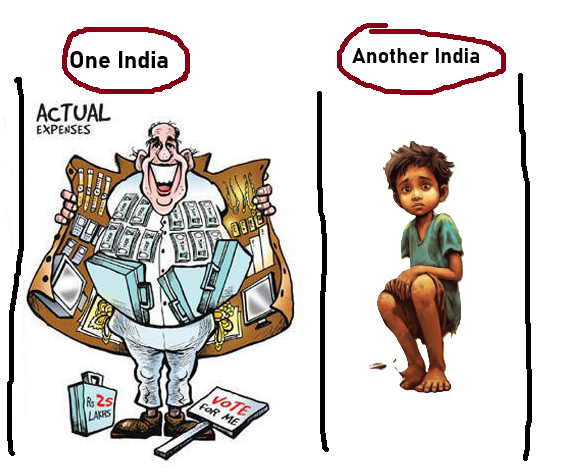
This essay posits a controversial but mathematically supported theory: India is not one country, but two. There is the India of the Politician, where the standard of living, income, and asset accumulation rivals that of Luxembourg, Switzerland, or Singapore. Then, there is the India of the Voter, where the per capita income and quality of life are statistically comparable to sub-Saharan African nations like Uganda. This economic apartheid is not accidental; it is a structural flaw where the prosperity of the representative acts as a disincentive to uplift the represented.
Part I: The Macroeconomic Mirage – High GDP, Low Dignity
To understand the disparity, we must first peel back the layers of India’s macroeconomic data. There is a deafening noise in the political sphere about India’s rise as an economic superpower.
The Trillion-Dollar Delusion
Leaders across the political spectrum frequently cite the nominal GDP figures. “We are a 4 trillion dollar economy,” they proclaim. “We will soon overtake Japan and Germany to become the 3rd largest economy in the world.” While these aggregate numbers are factually correct, they are functionally deceptive when applied to the welfare of the common man.
GDP (Gross Domestic Product) is a measure of the total economic output of a nation. It is akin to the total revenue of a massive corporation. However, a corporation can have high revenue while its workers are paid starvation wages. Similarly, a nation can have a massive GDP while its citizens remain destitute. This is where the metric of GDP Per Capita becomes the only relevant measure of human progress.
As of the mid-2020s, while India’s total GDP flies high, its GDP Per Capita languishes between $2,100 and $2,500 USD annually. To put this in perspective:
- India GDP Per Capita: ~$2,400
- China GDP Per Capita: ~$13,000
- USA GDP Per Capita: ~$80,000
- Luxembourg GDP Per Capita: ~$130,000
When our leaders celebrate overtaking the UK in total GDP, they conveniently omit that the average British citizen is roughly 18 to 20 times richer than the average Indian citizen. We are comparing the total wealth of 1.4 billion people against the total wealth of 67 million people. It is a victory of population size, not of economic efficiency or individual prosperity.
The Subsidy Trap
The most damning evidence of this low per capita income is the government’s own admission regarding food security. If the economy were truly robust for the common man, why is there a need to provide free grain to 80 crore people? This statistic reveals that nearly 60% of the population earns so little that market-rate food grains are considered a burden.
This creates a vicious cycle—the “Subsidy Trap.” Politicians campaign on promises of free electricity, free water, and free rations. The poor, desperate for immediate relief, vote for these short-term handouts. Once elected, the politicians amass wealth, while the voters remain poor enough to need the freebies again in the next election. The poverty of the citizen is the political capital of the leader.
Part II: The Anatomy of the Indian Legislator
To understand the “Switzerland” analogy, we must dissect the financial ecosystem of the Indian politician. The structure of India’s democracy is vast, but the number of key decision-makers is relatively small.
The Numerical Framework
India operates under a bicameral Parliamentary system at the center and Legislative Assemblies in the states.
- The Parliament (The Center):
- Lok Sabha (Lower House): 543 elected members. These are the direct representatives of the people.
- Rajya Sabha (Upper House): Up to 245 members (approx. 233 elected by state assemblies + 12 nominated).
- Total MPs: Approximately 788 individuals.
- The State Assemblies (The States):
- India has 28 states and 8 Union Territories.
- The total number of Members of Legislative Assembly (MLAs) across the nation is approximately 4,123.
- The Elite Club:
- When we combine MPs and MLAs, we are looking at a group of roughly 4,900 to 5,000 people.
In a country of 1.4 billion, these 5,000 individuals constitute the apex ruling class. They are the “super-citizens.”
The Official Remuneration: A Safety Net for the Rich
One of the greatest tricks played on the Indian public is the narrative that “politicians serve the nation for a modest salary.” While the basic salary might appear comparable to a corporate middle manager, the perks and allowances inflate the value astronomically.
1. Member of Parliament (MP) Earnings (2025-26 estimates):
The Salary, Allowances, and Pension of Members of Parliament Act ensures that MPs are insulated from the inflation that crushes the common man.
- Basic Pay: ₹1,00,000 to ₹1,24,000 per month (post-revision).
- Constituency Allowance: ₹70,000 to ₹90,000 per month.
- Office Expense Allowance: ₹60,000 to ₹75,000 per month.
- Daily Allowance: ₹2,000 to ₹2,500 per day when Parliament is in session.
The “Hidden” Wealth of Perks:
If a private citizen were to purchase the lifestyle provided to an MP for free, the cost would be staggering:
- Housing: A bungalow or large flat in Lutyens’ Delhi (one of the most expensive real estate zones in the world). Market Value of Rent: ₹3 Lakh – ₹10 Lakh per month.
- Medical: 100% free, world-class medical care for the MP and immediate family.
- Travel: Free First Class/Executive Class train travel; dozens of free business class air tickets annually.
- Communication: Free high-speed internet and telephones (tens of thousands of calls).
- Pension: A lifetime pension after serving just one day, which increases with every term served.
When you monetize these perks, an MP’s effective “Cost to Company” (to use corporate terminology) is easily ₹5,00,000 to ₹7,00,000 per month.
2. Member of Legislative Assembly (MLA) Earnings:
MLA salaries are the “Wild West” of Indian finance, decided by the state assemblies themselves. This leads to a conflict of interest where MLAs vote to hike their own pay.
- Telangana/Maharashtra: MLAs can take home ₹2.5 Lakh+ per month in cash components alone.
- Delhi/UP: ₹2.1 Lakh+ per month.
- Even in states with lower “basic” pay like Kerala, allowances buff the figure to a respectable middle-class income.
However, the salary is merely the pocket money of the Indian politician. The real comparison to Switzerland and Luxembourg comes from their Assets.
Part III: The Luxembourg Thesis – A Wealth Calculation
The main prompt introduces a compelling calculation: assessing the “GDP Per Capita” of a politician’s household based on their accumulated wealth. Let us formalize this mathematical argument to see if it holds water.
The “Crorepati” Norm
According to the Association for Democratic Reforms (ADR), the average assets of MPs and MLAs have skyrocketed. In the 2024 general elections, hundreds of MPs declared assets worth hundreds of crores. It is no longer an anomaly to find a candidate worth ₹50 Crore, ₹100 Crore, or even ₹500 Crore. In fact, politics has become a rich man’s game; the chances of winning an election in India are directly proportional to the assets declared by the candidate.
The Calculation of the “Politician’s Per Capita”
Let us adopt a conservative estimate, as suggested. Let us assume a “Standard Rich MLA” has a declared wealth of ₹10 Crore to ₹50 Crore. (Note: This is conservative; the top percentile owns vastly more).
Scenario: The ₹15 Crore MLA
Let us take a median figure of ₹15 Crore ($1.8 Million USD) in net assets (cash, real estate, jewelry, stocks).
1. Passive Income Generation:
If this wealth is managed even moderately well (conservative 6% return via Fixed Deposits, Rent, or Mutual Funds):
15,00,00,000 * 6% = 90,00,000 (90 Lakhs) per year.
2. Salary Income:
Adding the official salary and cash allowances (approx. ₹2.5 Lakh/month):
2,50,000 * 12 = 30,00,000 (30 Lakhs) per year.
3. Total Annual Income:
90 Lakhs + 30 Lakhs = 1.2 Crore per year.
4. Converting to USD (Exchange rate ~₹90):
1,20,00,000 / 90 ~$133,333 USD.
Note: The actual income of our political representatives is much higher than the amount used in this calculation. The rate of change from one political party to another is not free, either, and even less so. Flats in every city, shares in many companies, land, ownership of shell companies to adjust black money to make it white, and many more. So, it could be a mountainous amount. The disclosed income is just the tip of the iceberg.
The Comparison
Now, let us compare this annual income of the “Average Rich Politician” in India to the GDP Per Capita of the world’s wealthiest nations:
- Luxembourg GDP Per Capita: ~$135,000
- Ireland GDP Per Capita: ~$112,000
- Switzerland GDP Per Capita: ~$92,000
- Singapore GDP Per Capita: ~$88,000
- USA GDP Per Capita: ~$80,000
- Indian Politician (Projected): ~$133,333
The Conclusion: The Indian politician is not living in India. Economically speaking, they are living in a super-state that ranks higher than Switzerland and Luxembourg. Their purchasing power, shielded by free perks and fueled by immense asset accumulation, places them in the top 0.01% of the global population.
Meanwhile, the voters they represent earns $2,400.
The ratio of Representative Wealth to Citizen Wealth is approximately 60:1.
Part IV: The Uganda Reality – The Citizens’ Struggle
While the MP lives in “Switzerland,” the constituent lives in “Uganda.” This comparison is not meant to disparage Uganda, a developing nation with its own challenges, but to highlight the economic bracket in which the average Indian citizen falls.
The $2,400 Life
What does a GDP Per Capita of $2,400 (approx. ₹2 Lakh per year or ₹16,000 per month) look like?
- Healthcare Crisis: It means one major illness destroys the family’s financial future. While the MP flies to AIIMS or abroad for treatment, the citizen waits in line at a district hospital where beds are shared and medicines are out of stock.
- Education Deficit: It means relying on dilapidated government schools or paying exorbitant fees for private schools that drain 40% of the household income. The MP’s children, conversely, often study in the UK or the US.
- Nutritional Poverty: It means a diet heavy in carbohydrates (rice/wheat) and low in proteins, leading to stunting and lifestyle diseases.
- Housing Insecurity: It means living in unauthorized colonies with poor drainage, facing the threat of demolition or flooding, while the “servant of the people” lives in a sprawling Lutyens bungalow maintained by the PWD.
This is the reality of the “Uganda” class in India. They are the vote bank. They are the ones who need the 5kg of free rice because the system has failed to provide them with the jobs required to buy that rice themselves.
Part V: The Conflict of Interest – Why Development Stalls
The central question raised is: Why hasn’t this changed in 77 years?
If our leaders are so capable, so wealthy, and so powerful, why are we still a developing nation?
The answer lies in the Conflict of Interest.
The “Already Developed” Syndrome
If you are living in a house that rivals a Swiss villa, driving a German car, sending your kids to American universities, and getting treated in world-class hospitals, then India is already a developed nation for you.
For the politician, the roads are not bumpy because they travel in SUVs with high-end suspension. The power cuts do not affect them because they have industrial generators. The inflation of tomato prices does not matter because their kitchen budget is a fraction of their income.
Because they are personally insulated from the failures of the state, they lack the visceral urgency to fix them.
The Incentive to Keep Poverty Alive
There is a darker political calculation at work. A financially independent, well-educated, and middle-class population is difficult to manage. They ask questions. They demand accountability. They argue about policy, taxes, and rights.
A poor, dependent population, however, is easy to manage.
- If a voter is hungry, a bag of rice buys their loyalty.
- If a voter is unemployed, a vague promise of a government quota wins their support.
- If a voter is uneducated, emotional rhetoric about caste or religion distracts them from economic reality.
Therefore, the persistence of poverty is not an accident; for many in the political class, it is a business model. Maintaining a “Uganda-like” citizenry ensures a steady supply of desperate voters who can be bought cheaply during elections. If the citizens became “Swiss,” the current breed of politicians would become obsolete.
Part VI: The Future – 2090 and Beyond
The projection for the future is grim if the status quo persists. The individual paints a dystopian picture of the year 2090 or 2100: Politicians fighting elections over 10kg of rice, wheat, and grains.
This is not science fiction; it is the trajectory of current data.
- Technological Feudalism: We are moving toward a state where the gap between the rulers and the ruled is not just economic but technological. The elite will have access to AI, genetic modifications, and advanced healthcare, while the masses struggle for basic digital literacy.
- The Hereditary Rule: Politics in India has become a family business. The wealth and the seats are passed from father to son/daughter. This creates a permanent ruling aristocracy—a “Monarchy with Democratic Characteristics.”
The “Stupid Indian” Fallacy
Many people note, “This lifestyle they afford is due to Stupid Indians.” While harsh, this sentiment reflects the frustration of the taxpayer. Every time we vote based on caste, creed, religion, or short-term freebies (a mixer grinder, a bottle of liquor, a cash handout), we are essentially signing a contract that says: “I will trade my next 5 years of development for this immediate, low-value gratification.”
We choose representatives who become rich, effectively transferring our sovereign power to them to build their own private empires. We are not just voters; we are the venture capitalists of their political startups, but we never get the dividends—only they do.
Part VII: Conclusion – Breaking the Cycle
The comparison is undeniable. We have created a system where our employees (the politicians) live better than the employers (the citizens).
- The MP is the Swiss Banker.
- The Citizen is the Ugandan Farmer.
India cannot become a developed nation as long as this disparity exists. A nation is not developed when its top 1% lives like kings; it is developed when its bottom 20% lives with dignity.
To change this, the metrics of success must change.
- Link Salaries to Performance: Perhaps MLA/MP salaries should be pegged to the Median Income of their constituency. If the people get richer, the leader gets richer.
- Abolish Hidden Perks: If an MP wants to travel, let them pay from their salary. If they want healthcare, let them use the government hospitals they oversee. Only when they are forced to use the public infrastructure will the infrastructure improve.
- Voter Awakening: The cycle breaks only when the voter realizes that a bag of rice today is the price of their child’s unemployment tomorrow.
Until we bridge the gap between the “Luxembourg” in the Parliament and the “Uganda” in the streets, the dream of a developed India will remain just that—a dream, recited in speeches but never realized in the ledger of the common man’s life.
 Views Today :
  Views Yesterday : 1
 Total views : 1798
Leave a Reply