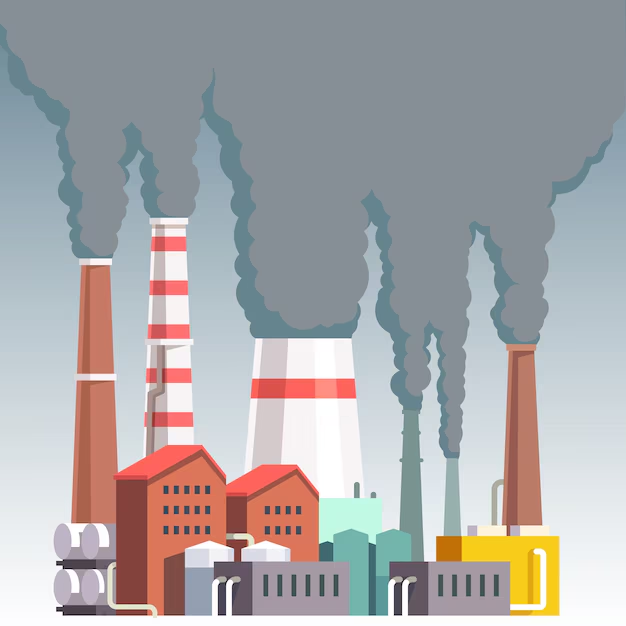
Air pollution in India’s national capital has repeatedly reached hazardous levels, drawing global attention for all the wrong reasons. New Delhi, a symbol of India’s aspirations, culture, and history, has unfortunately become equally symbolic of the country’s struggles with environmental governance and long-term planning. In many international forums and headlines across the world, Delhi’s smog is portrayed not merely as an environmental challenge but as a national embarrassment—an avoidable crisis allowed to continue year after year. What makes this situation even more troubling is that while many countries have demonstrated remarkable success in curbing pollution through sustained policy interventions, scientific research, and public cooperation, India remains trapped in a cycle where the issue surfaces with alarming intensity, receives brief attention, and then gradually fades into the background until the next crisis emerges.
In several global cities—whether it is London’s historic battle with smog, Beijing’s aggressive pollution-control reforms, or Los Angeles’ decades-long effort to regulate vehicular emissions—governments have shown that when political will aligns with scientific action, pollution can be substantially reduced. These cities invested in identifying pollution sources, enforcing stringent regulations, modernizing infrastructure, promoting clean energy, and empowering scientists to lead evidence-based interventions. Their achievements prove that air pollution, no matter how severe, is not insurmountable. Yet, India continues to oscillate between acknowledgement and apathy.
One of the core challenges in India is the episodic nature of public and political engagement with pollution. For a short period during winter—when toxic smog blankets Delhi—the issue dominates headlines, discussions, and public debate. But once the weather changes and the air clears slightly, attention shifts elsewhere. New political narratives replace old ones, and pollution, despite being a perennial threat, becomes invisible again. Unlike in other countries where environmental issues remain integral to public policy and governance, in India pollution often appears as a seasonal headline rather than a priority requiring sustained action.
Another major concern is the overwhelming dominance of political news in Indian media discourse. A cursory look at newspapers or television channels reveals that nearly 90% of prime-time content revolves around politics, elections, controversies, and debates. Social issues like pollution, health care, education, or environmental degradation receive fragmented attention—brief segments, scattered articles, or one-off discussions. These social issues appear almost like advertisements: they come and go, loud for a moment and silent the next. Even when air quality dips to levels considered dangerous by global standards, the issue is rarely addressed with the urgency and continuity it deserves.
When air pollution reaches hazardous levels—levels so extreme that they surpass what is scientifically categorized as “severe”—the fundamental question emerges: Who is responsible? Is it the government? The people? Industries? Agricultural practices? Or a combination of all these? In reality, pollution is a multi-source problem, but the ultimate responsibility for preventing such crises lies with the government. The government is the central authority entrusted with ensuring safe living conditions for citizens. It has the power to regulate industries, monitor emissions, implement public health interventions, promote sustainable agriculture, and enforce environmental laws. While citizens, farmers, industries, and institutions indeed play roles, their actions are shaped, guided, and controlled by governmental policies. If the government acts promptly, decisively, and intelligently, most sources of pollution can be minimized or eliminated entirely.
However, what India witnesses instead is a continuous blame game. Every time pollution spikes, the government in power blames the previous government, and the previous government blames the one before it. This political ping-pong has been going on for decades. No government wants to accept accountability, and none are willing to acknowledge failures within their own tenure. This cyclical blame system conveniently avoids responsibility while doing little to address the root causes of pollution. Meanwhile, citizens remain trapped in toxic air, deprived of the fundamental right to breathe clean air.
A deeply disturbing reality is the stark contrast between how ordinary citizens and government officials experience the pollution crisis. Those in power—elected representatives, ministers, and senior bureaucrats—enjoy luxurious facilities: centrally air-conditioned homes and offices, advanced air purifiers, clean filtered water, medical care in top private hospitals, and even access to international treatment funded indirectly by taxpayers. Their families live protected lives within privileged environments. Citizens, on the other hand, particularly the poor and middle class, are forced to breathe toxic air daily. Children, elderly individuals, and patients with respiratory conditions are the worst affected, often developing lifelong health complications.
What is even more troubling is the state’s response when ordinary people demand clean air and clean water—basic human rights and fundamental necessities for survival. Instead of empathy, solutions, or sincere engagement, they often receive police lathicharge, restrictions, or political accusations. Peaceful citizens demanding accountability are often treated as obstacles, not stakeholders. This raises a painful question: How far has our democracy and politics drifted from the welfare of the people? The people who pay taxes—who fund every government project, salary, and public facility—are the same people who must bear the consequences of environmental degradation without protection or justice.
The irony becomes sharper when one sees how extravagantly governments spend public money. Huge amounts are wasted on political advertisements, hoardings, rallies, self-promotion, media campaigns, and personal luxuries for political leaders. From elaborate security arrangements to VVIP treatments, expensive vehicles, lavish bungalows, and even high-end gadgets such as iPhones, iPads, and MacBooks gifted to politicians—public money is routinely diverted for non-essentials. Yet, when it comes to funding scientific research, environmental monitoring, or pollution-control initiatives, the same governments claim insufficient budgets.
This contradiction exposes the priorities of the political class. Instead of investing in long-term scientific solutions, governments prefer temporary political gains and optics. But solving air pollution requires consistent research, accurate data, scientific expertise, and long-term planning. The first step in tackling pollution is identifying the sources with precision. Without scientifically mapping emissions—industrial pollutants, vehicular emissions, construction dust, biomass burning, agricultural stubble burning, waste incineration, power plant emissions, and household fuels—effective solutions cannot be formulated. Surprisingly, India lacks comprehensive year-round research projects on air quality. While numerous international institutions invest heavily in environmental science, India has not adequately funded its own researchers, universities, and scientific bodies to conduct extensive studies.
Universities, postdoctoral researchers, and scholars in India possess immense talent. They are capable of conducting advanced atmospheric modeling, chemical analysis, satellite monitoring, and emission-source apportionment studies. But they require funding, infrastructure, and long-term grants—resources that remain insufficient or inconsistently available. If the government allocates even a fraction of what it spends on political promotions, it would be enough to sustain dozens of high-quality research programs on air quality, pollution control, and sustainable technologies. A strong commitment to funding research would help identify not only major pollution sources but also propose effective, implementable solutions for reducing emissions.
Moreover, empowering universities and research institutions would allow the development of localized pollution-control strategies. Different regions have different emission profiles. Rural pollution sources differ from urban. North Indian smog is distinct from industrial pollution in western India or coastal pollution in the south. Without region-specific research, generic national policies cannot succeed. Scholars and environmental experts can categorize pollution sources based on priority, severity, and contribution to air quality deterioration. They can also suggest targeted policy interventions—whether stricter industrial norms, cleaner agricultural technologies, waste management reforms, renewable energy expansion, or urban planning measures.
But for all this to happen, political will is the most crucial requirement. No major environmental reform has ever occurred anywhere in the world without strong political commitment. Unfortunately, in India, pollution remains secondary to political narratives, electoral strategies, and ideological battles. Governments seem more interested in protecting their political image than protecting public health. When data, research, or experts highlight failures, governments dismiss them or shift the blame.
After repeatedly witnessing the same patterns, it becomes difficult to believe that any government is genuinely interested in solving pollution. If pollution disappears as an issue, politicians would lose a convenient tool for blame politics. Every winter provides an opportunity to criticize opponents, attack previous administrations, or manipulate public emotions. As long as pollution remains unresolved, it remains politically useful.
Yet the people suffer. Citizens who work hard, pay taxes, contribute to the nation’s economy, and uphold democratic institutions are left gasping for clean air. They pay taxes with the belief that their money will be used for public welfare, infrastructure, health, education, safety, and sustainable development. But a significant portion of these taxes ends up funding luxurious lifestyles of politicians, extravagant events, and wasteful public relations exercises. In effect, the common people fund their own suffering while the privileged class remains insulated from the consequences of their governance failures.
All this raises a profound philosophical and civic question: For whom are the citizens working? Whose welfare is ultimately being prioritized? If the taxes of millions of hardworking Indians cannot guarantee clean air—a basic necessity for life—then the entire purpose of governance comes into question.
If India truly wants to address air pollution, it must fundamentally change its approach. Token measures and seasonal responses are inadequate. The country needs a structured, scientific, and long-term national program for air quality management. This requires:
- Strong political commitment beyond party lines
- Substantial investment in scientific research
- Empowering environmental scholars and universities
- Transparent, year-round air-quality monitoring
- Strict enforcement of industrial and vehicular laws
- Clean energy expansion
- Agricultural reform through incentives and technology
- Public participation and awareness
- Accountability mechanisms for government bodies
Even moderate progress in these areas would significantly improve air quality within five years. Countries like China have demonstrated that drastic improvements are possible with sustained action. India does not lack the intelligence, talent, or resources—it lacks prioritization.
Unless governance shifts from blame to responsibility, from politics to science, and from short-term optics to long-term solutions, the pollution crisis will continue to repeat itself every year. In the end, the citizens—those who contribute the most to the nation—will continue to bear the consequences.
 Views Today :
  Views Yesterday : 1
 Total views : 1798
Leave a Reply